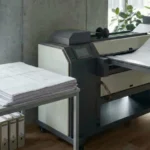
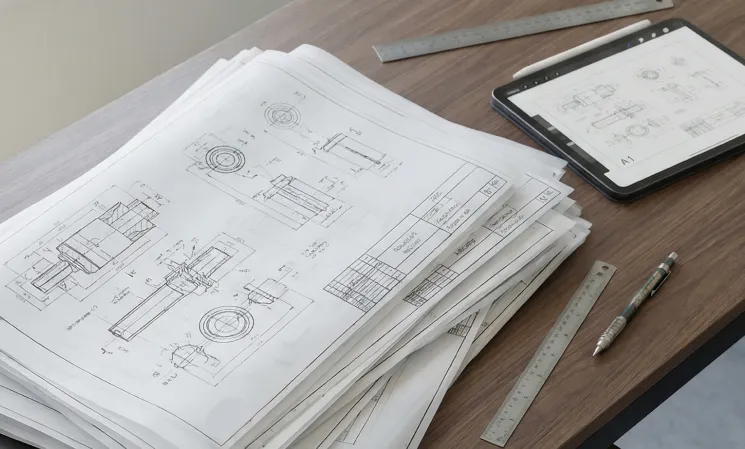
In modern V2D FOLDER folding machines, these approaches correspond to three programmable folding methods:
- Folding with a margin – equivalent to Z‑folding or parallel folding that leaves a margin for binding.
- Folding without a margin with the excess in the centre of the document – classic accordion fold, convenient for documents that are frequently unfolded and refolded.
- Folding without a margin with the excess at the end of the document – a variation of accordion or Z‑folding where the excess paper is shifted to the end of the folded block.
In this article we will explore the features of each method and show which V2D FOLDER models are best suited for their implementation.
Folding with a margin (z‑fold / parallel with a margin)
What it looks like:
The document is folded so that one edge (usually the left) remains free. This edge is used for binding into a binder or clip folder. The folds can be arranged in a Z‑shaped pattern or as parallel folds, but the key element is the presence of a constant margin.
Which documents it suits:
- Sets of drawings submitted for expert review or to a customer that require binding.
- Project documentation stored in binders with clamps.
- Any documents where it is important to retain the possibility of subsequent binding.
Advantages:
- Versatility: the margin can be used for binding without damaging the content.
- The folded block has a neat, uniform appearance.
Implementation features in V2D FOLDER equipment:
- All four models (IA4, OA4C, OA3, IA4C) support the folding with a margin method.
- For fully automatic folding into A4, this method is available with the option of leaving the margin or automatically cutting it off (models OA4C, IA4C, and also IA4 when working with A4 format).
- For semi-automatic folding of A0–A3 formats, the folding with a margin method is used without cutting, preserving the margin for binding.
Folding without a margin with excess in the centre (accordion)
What it looks like:
The sheet is folded alternately forward and backward, and the excess paper ends up in the centre of the folded block. This pattern resembles a classic accordion and ensures even distribution of folds.
Which documents it suits:
- Drawings that are repeatedly unfolded and refolded (construction sites, on‑site approvals).
- Documents that do not require binding but need compact storage with easy access to any part.
Advantages:
- Folds are not concentrated in one place, which increases paper longevity.
- Convenient to lay out on a desk for work.
Implementation features in V2D FOLDER equipment:
This method is available on all models. It is especially useful:
- For fully automatic folding into A4 (IA4, OA4C, OA3, IA4C) – the excess is automatically centred.
- For semi-automatic folding of large formats (A1, A2, A0) – the operator can select this method via the interface, and the machine will perform the fold without trimming, keeping the excess centred.
Folding without a margin with excess at the end (offset accordion)
What it looks like:
The sheet is folded so that the excess paper ends up at the end of the folded block. When unfolded, the last section protrudes beyond the others, which can be convenient for quickly finding the beginning of the document.
Which documents it suits:
- Long drawings where it is important that the start (title block) always ends up on top.
- Documents that will be stored in vertical hanging systems.
- Automated lines where a strictly defined position of the excess is required for subsequent processing.
Advantages:
- Allows precise control of the title block position.
- Simplifies sorting of folded sheets.
Implementation features in V2D FOLDER equipment:
This method is also supported by all models. It is especially useful:
- In combination with a printer (synchronization is available on IA4C and OA4C) – the excess is automatically formed at the end, eliminating manual trimming.
- When setting up sequential execution of several jobs with different parameters (this function is available on IA4 and OA3).
How to choose the method and model for your tasks
If your documentation is bound in folders
Choose folding with a margin. For large A4 volumes, OA4C or IA4C are optimal – they provide automatic edge trimming (if required) and high speed. If you work mainly with A1–A3 formats and do not need trimming, the IA4 will suffice.
If drawings are frequently unfolded on site
Use folding without a margin with the excess in the centre. This accordion fold is convenient for repeated use. Any model can handle it, but for large formats (A0), it is better to choose OA4C or IA4C – their longitudinal folding axis ensures stability when folding long sheets.
If precise control of the title block position is important
Use folding without a margin with the excess at the end. This is especially relevant when feeding automatically from a printer. The IA4C and OA4C models support printer synchronization and allow full automation of the process.
If you work with different formats and materials
All V2D FOLDER models process paper up to 120 g/m², including thermal paper and glossy materials. For maximum flexibility, consider the IA4C (touch screen, programmable settings) or IA4 (integrated work table for manual and automatic feeding).
The three folding methods implemented in V2D FOLDER folding machines fully cover the needs of working with technical documentation: from binding into folders to repeated use of drawings on site. The choice of a specific model depends on which formats you work with most often and what level of automation you require.
If you are unsure which method and which model would best suit your tasks, contact us, and we will help you select the right equipment.